
#128 - Unpacking Agentic Payments in Africa
Agentic commerce is being designed around retail. In Africa, the larger opportunity may sit inside purchase orders, invoices and corporate supply chains.


Illustration by Mary Mogoi (New Link)
Hi all - This is the 128th edition of Frontier Fintech. A big thanks to my regular readers and subscribers. To those who are yet to subscribe, hit the subscribe button below and share with your colleagues and friends.
Thanks for reading Frontier Fintech Newsletter! Subscribe for free to receive new posts and support my work.
I’d greatly appreciate if you could take 3 minutes max to fill out this survey. I want to make your experience with FF better.
Introduction
The closest thing I have to a personal vision of hell is an afternoon spent shopping at the mall.
I dislike nearly every part of the process: walking from shop to shop, comparing versions of products I barely care about, queuing to pay and then discovering that the one thing I came for is out of stock. I am, regrettably, one of those husbands who starts sulking halfway through a shopping trip with his wife. If I could receive the things I need without enduring the shopping, I would be very happy. My love language is practical procurement. Buy me something I need but will procrastinate over replacing; a pair of socks or a toothbrush and I will feel profoundly cared for. This perhaps explains why my wife means so much to me. She does this brilliantly.
Agentic commerce sounds almost purpose-built for people like me. Imagine an AI agent that knows when the milk is likely to have run out, notices that the toothpaste should be nearly finished and assembles a Glovo basket from my previous purchases. It could check what is in stock, compare prices, make sensible substitutions and present the basket for approval. With more authority, it could place the order by itself.
The really interesting version would understand more than my consumption. It would understand my circumstances. In a tight month, the agent might switch brands, postpone discretionary items or reduce quantities. It would absorb dozens of small decisions that currently take up time and cognitive energy, leaving me to focus on work or my family.
For someone who hates shopping, this sounds like heaven. It also reveals why agentic commerce is more complicated than giving software access to a card. The agent must understand what I need, which merchant can supply it, what substitutions I would tolerate, how much I can afford and how much authority I am willing to surrender. Shopping combines discovery, judgement, trust and payment. Moving the money may be the easiest part.
Agentic commerce and agentic payments are rapidly becoming part of the technology zeitgeist. Executives will increasingly be asked whether their institutions should invest, partner, experiment or wait. The industry vocabulary is moving faster than most people’s understanding of how these systems work. That creates fertile ground for misplaced bets: capital committed to the wrong use cases, teams assembled before the underlying infrastructure exists and management time spent chasing technology that does not solve a sufficiently valuable problem.
This week, I want to build a practical framework for thinking about agentic payments and agentic commerce from the ground up. I’ll begin with what they are and why they are arriving now, before examining how the global industry is creating common standards that allow agents to communicate with merchants and complete transactions. I’ll then separate product discovery from the purchase itself, because each depends on a different set of data and capabilities.
Finally, I’ll test the global consumer thesis against African commercial realities and use the S-curve framework to identify where agentic payments could take hold first. My suspicion is that the most fertile ground may sit away from the shopping mall, inside corporate procurement and cross-border trade.
From Answers to Action - The Agent Era
The AI we met at the end of 2022 was simultaneously impressive and deeply unreliable. ChatGPT could draft an email, summarise a document or explain a difficult concept in seconds. It could also invent a fact, citation or entire legal case with complete confidence. We could ask AI to help us think. Trusting it with our money would have seemed absurd.
My own behaviour reflected this. A few years ago, I proof-read almost everything AI produced, checking each claim and rewriting large parts of the text. I still verify consequential work, particularly numbers and sources. Nonetheless, I no longer approach every paragraph with the assumption that something has probably gone wrong. I increasingly delegate entire pieces of work: search through a set of documents, compare competing arguments, interrogate the evidence and produce a structured answer.
This shift has come from several improvements arriving together. The first is scale. Researchers found that model performance improved predictably as developers increased the amount of data, model capacity and computing power used during training. These scaling laws, combined with much larger AI computing clusters, produced more capable underlying models.
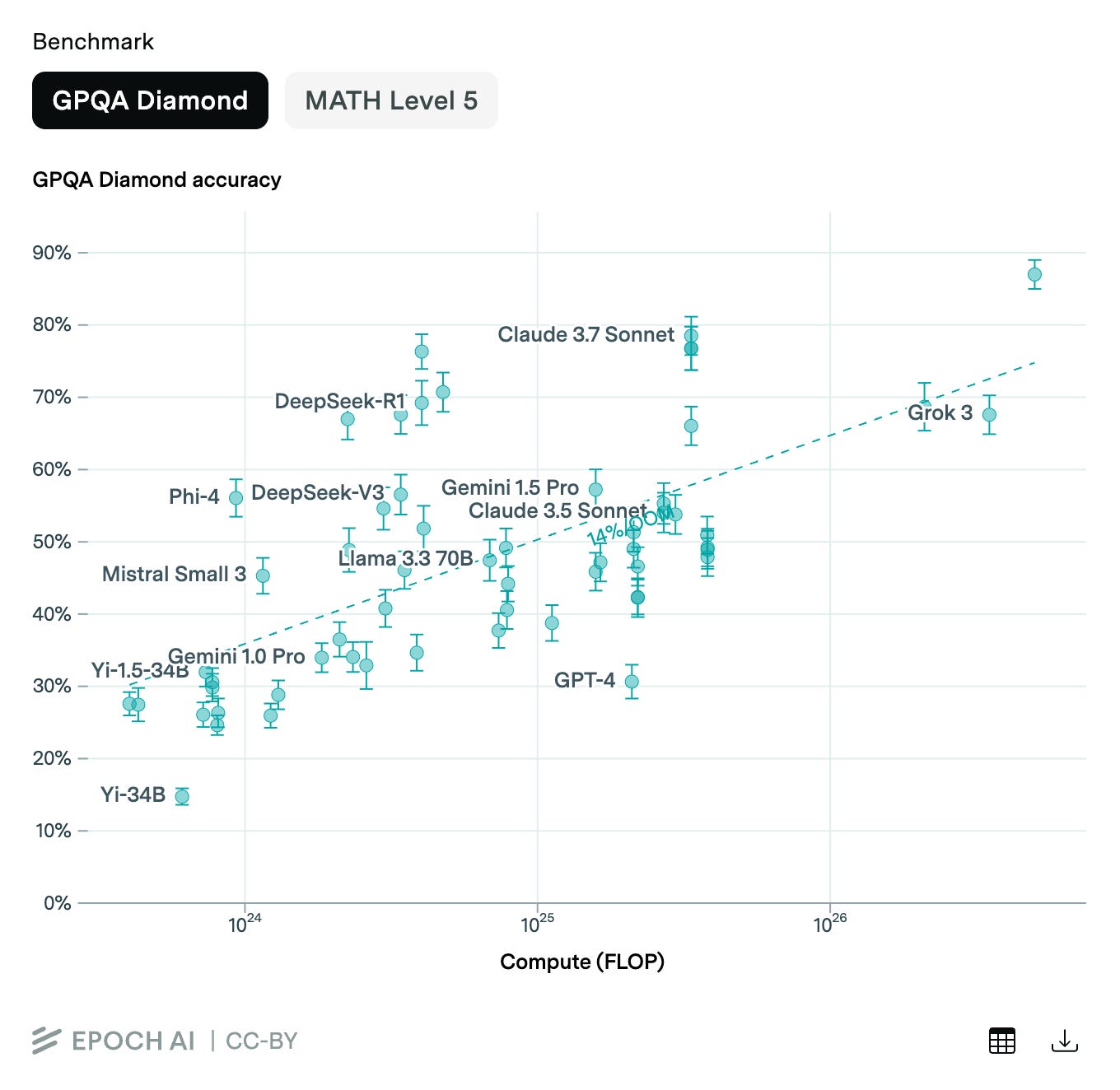
The diagram above from Epoch AI shows models getting smarter the bigger the compute they’re trained on.
The second improvement has occurred after the initial training. Better post-training has taught models how to follow instructions and work through complex problems. At the point when we ask a question, reasoning models can also spend more computing power working through it. This is known as test-time compute: performance can improve when a model is allowed to spend longer reasoning before responding. OpenAI demonstrated this with its o1 models.
Context windows have also grown, allowing AI systems to hold more documents, instructions and prior work in view. Give these models access to search, databases, software and other tools, and the unit of value begins to change. The AI moves from producing an answer to pursuing an outcome. An agent can plan a task, use tools, assess what it finds, adjust its approach and continue working across several steps. This is the basic distinction between a chatbot and an AI agent.
Commerce is a natural extension of this progression. If an agent can conduct research or organise a trip, it should eventually be able to act on what it discovers. Buying can be broken into four stages.
First, intent: I describe the outcome I want and the constraints that matter. Second, delegated authority: I determine what the agent may do, how much it may spend and when it must return to me for approval. Third, parallel discovery: the agent searches several merchants simultaneously, comparing products, prices, stock and delivery terms. Finally, transaction completion: it selects the merchant, places the order, instructs payment and tracks fulfilment.
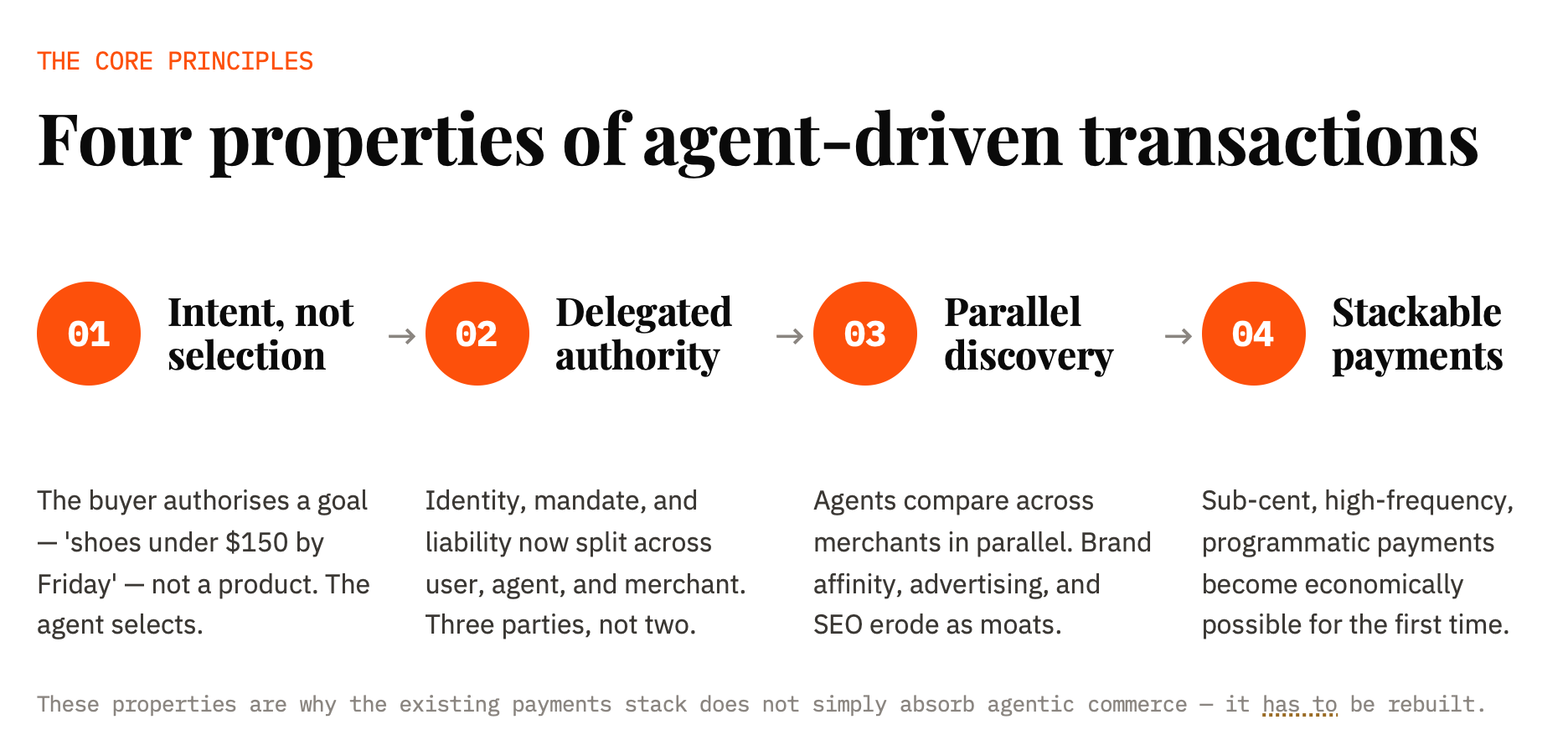
Source: Frontier Fintech Internal Research
Each stage demands more than intelligence. The agent must communicate with merchants, interpret their information and prove that it has authority to act. Once software becomes the buyer, commerce needs a common language that machines can understand.
Giving Machines a Common Language
The internet economy runs on a collection of relatively unremarkable standards. TCP/IP allows different computers and networks to exchange data reliably. HTML gives websites a common way to structure information. GSM standards allowed phones produced by different manufacturers to connect to mobile networks, while USSD created a simple channel through which users could interact with services from basic phones.
Uber did not have to build a global communications network before launching its application. M-Pesa did not have to place a smartphone in every Kenyan’s pocket. Both companies could build on infrastructure and protocols that already existed. Standards reduced the number of things each company had to solve. Fundamentally that’s how industries grow and its a framework that was deeply imprinted in my psyche by Dare Okoudjou of Onafriq. You can listen more in our podcast below.
Agentic commerce faces a similar problem. An individual agent can be taught how to purchase something from one merchant. Billions of agents cannot operate seamlessly if each requires a separate connection to every merchant, bank, payment company and identity provider. The industry needs shared rules governing how agents discover products, establish authority, complete orders and move money.
The emerging system can be understood as a five-layer cake.
The consumer interface is where we express intent. This could be ChatGPT, Gemini, WhatsApp, a bank application or a company’s procurement system.
The reasoning layer interprets that intent, plans the task, compares the available options and decides what action to take within the user’s constraints.
Commerce protocols give agents and merchants a common language. They must describe products and services, prices, availability, delivery terms, discounts, carts, orders, fulfilment, returns and refunds.
Trust and identity protocols establish who the user, agent and merchant are. They also provide evidence that the agent was authorised to act, define the limits of that authority and create an audit trail when something goes wrong.
The settlement layer transfers value through cards, bank accounts, mobile money, real-time payment systems or stablecoins.
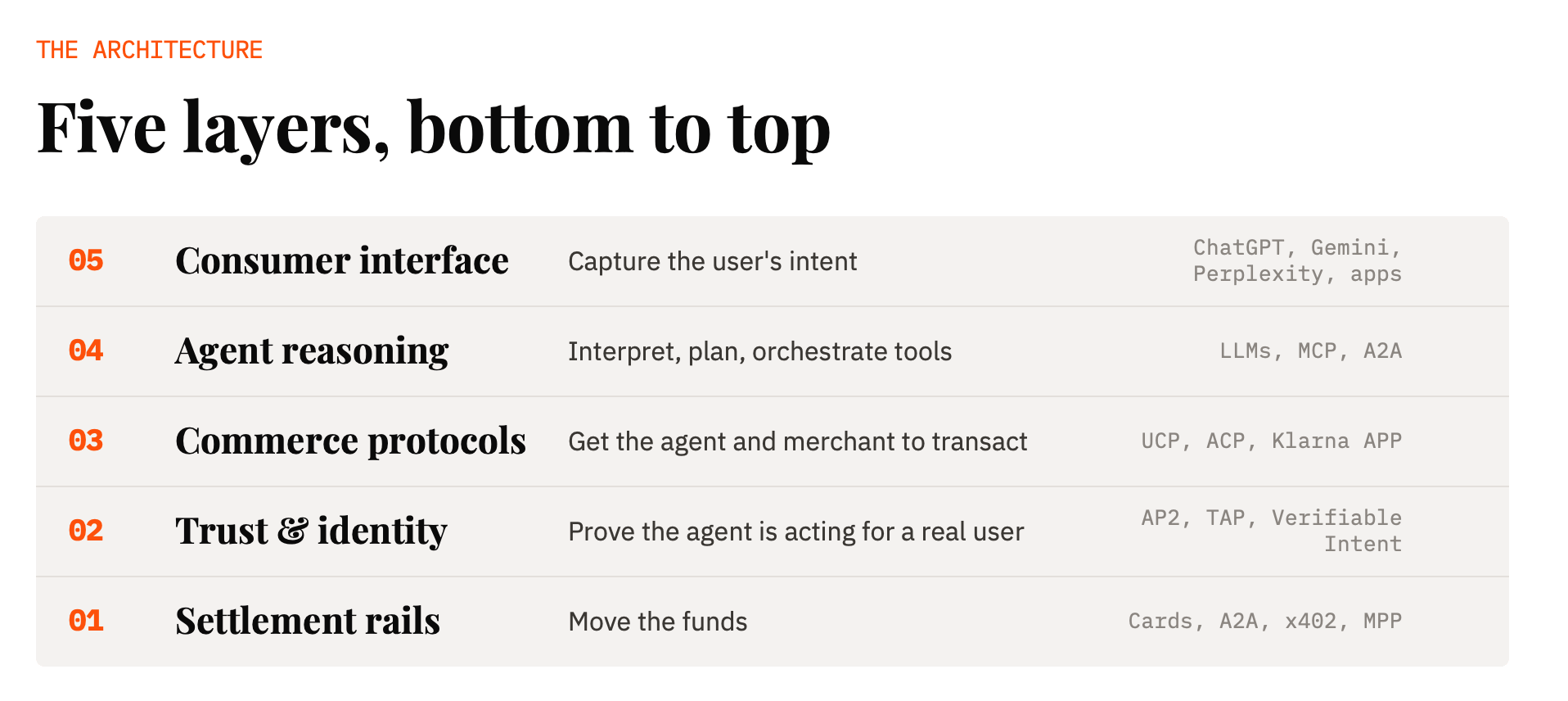
The current scramble to build standards covers different parts of this stack. Google’s Universal Commerce Protocol seeks to standardise the journey from product discovery and checkout through to order management. OpenAI and Stripe’s Agentic Commerce Protocol performs a similar function between AI interfaces and merchant systems, using structured product information while leaving payment, fulfilment and customer service with the merchant.
Google’s Agent Payments Protocol, or AP2, concentrates on trust. Its cryptographically signed mandates record what the user requested, what the agent was permitted to do and what the final cart contained. This creates evidence connecting the original intent to the eventual payment.
Coinbase’s x402 and Stripe and Tempo’s Machine Payments Protocol address a different environment: machines purchasing digital services from other machines. A service can respond to an agent’s request with a price; the agent pays and receives access. x402 was designed around stablecoin payments, while MPP can support stablecoins and conventional methods such as cards.
In essence, the industry is trying to make commerce composable. Any authorised agent should eventually be able to communicate with any participating merchant, understand what is being sold, prove its mandate and pay through an appropriate rail. The protocols may provide the grammar. Their usefulness will still depend on the quality of the commercial information they are being asked to carry.
Technology with African Characteristics
Often in African tech discourse, African nuance becomes African exceptionalism which in my view is lazy thinking. It’s always useful to separate what will matter and what will remain the same and the latter is often the bucket where most things fall into.
The protocols discussed in the previous section will matter on the continent. TCP/IP and HTML mattered. GSM standards, coordinated across the mobile industry by bodies such as the GSMA, mattered enormously. USSD mattered. These standards became part of the infrastructure on which African fintech was built. Agentic commerce will be no different. Its agents will use the same reasoning models, identity standards and payment protocols emerging globally.
The difference as always will be on how these models are adapted for some African characteristics. This often happens when technology encounters the continent’s incomes, institutions, infrastructure and commercial behaviour. USSD became more important here because it worked on inexpensive phones without requiring mobile data. Mobile money developed around agent networks because cash remained central to everyday commerce. Digital lenders attached themselves to mobile-money transaction histories because conventional credit files were thin.
The underlying technologies travelled. The products that succeeded reflected the markets they entered. The most useful framework I have found for evaluating where agentic commerce might take hold is the S-curve. New technologies typically begin with a long period of experimentation, enter a steep phase of adoption once the economics and infrastructure align, and eventually flatten as the market approaches saturation. The technology alone does not determine when that curve begins. The interaction between the technology and the local economy is what’s critical.
Africa’s previous fintech S-curves suggest three conditions matter.
The first is an existing behaviour. M-Pesa digitised the practice of sending money home through friends, relatives and bus drivers. Digital credit formalised the small, short-term borrowing that already occurred through shopkeepers, employers and family networks. Technologies scale faster when they improve something that millions of people or businesses already do.
The second is a 10x improvement in cost, speed or friction. Sending money through M-Pesa was dramatically faster and safer than placing cash on a bus. Instant payments collapsed settlement times from days to seconds. A marginal improvement rarely provides enough incentive for users or institutions to change established behaviour.
The third is a large underlying market. The behaviour must represent enough users, transactions or economic value to sustain investment in the infrastructure required to serve it. This is especially important for agentic systems, which will need integrations across merchants, corporate systems, identity providers and payment rails.
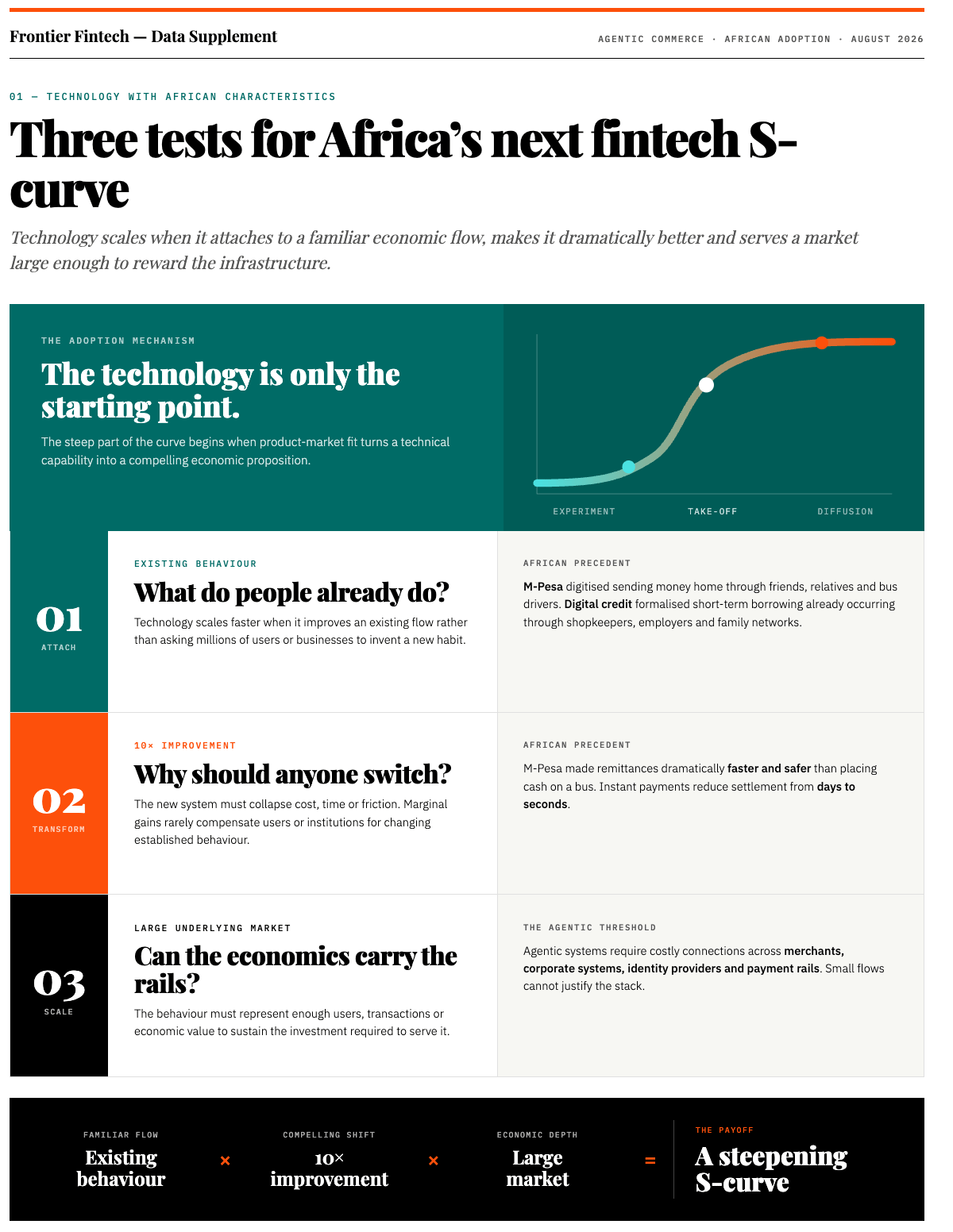
These three tests give us a way to move beyond the zeitgeist. We can examine each potential use case by asking whether it attaches itself to an existing flow, produces an order-of-magnitude improvement and addresses a sufficiently large market. That should tell us where Africa’s agentic-commerce curve is most likely to begin.
Where Can Agents Act
Commerce across much of Africa looks different from the environment for which today’s agentic protocols are being built. We encountered this problem in The M-Kopa vs Lipa Later Paradox. Both companies could broadly be described as Buy Now, Pay Later, but their models were different.
Lipa Later embedded short-term credit into a formal retail checkout. M-Kopa finances smartphones and solar systems that help customers earn income or reduce an essential expense. Repayments happen through mobile money and the device provides security. The same technology took on different characteristics when it encountered different incomes, retail systems and customer needs. Agentic commerce will follow the same pattern.
Recurring payments offer one clue. Wiza Jalakasi has explained how cardholders can authorise a merchant once and continue paying until they opt out, while mobile-money users generally approve every payment. Many people earn unevenly and manage expenditure through prepaid purchases, buying the electricity, data or entertainment they can afford until more income arrives.
An agent asks the consumer to delegate even more authority: deciding what to buy, when to buy it and whether the account can afford it. Many consumers may delegate discovery, price comparison and cart construction while retaining control of the final payment. This creates a delegation ceiling that the global agentic-commerce thesis does not always acknowledge.
The infrastructure also differs. Across many African markets, digital commerce happens through Instagram, Facebook and WhatsApp. A customer may discover a product in a post, negotiate over WhatsApp, pay through mobile money and arrange delivery through a motorcycle rider. The catalogue may consist of photographs. Inventory may sit in someone’s memory. Prices may be established during the conversation.
Jumia encountered an earlier version of this constraint. It entered markets without the cheap postal networks, consistent addressing and digital-payment habits that supported e-commerce elsewhere. It had to build payments, logistics and fulfilment alongside the marketplace. Agentic-commerce protocols cannot remove that work. A common language helps an agent communicate with a merchant system; it does not create accurate inventory where none exists.
The S-curve framework helps us define the surface on which an agent can act.
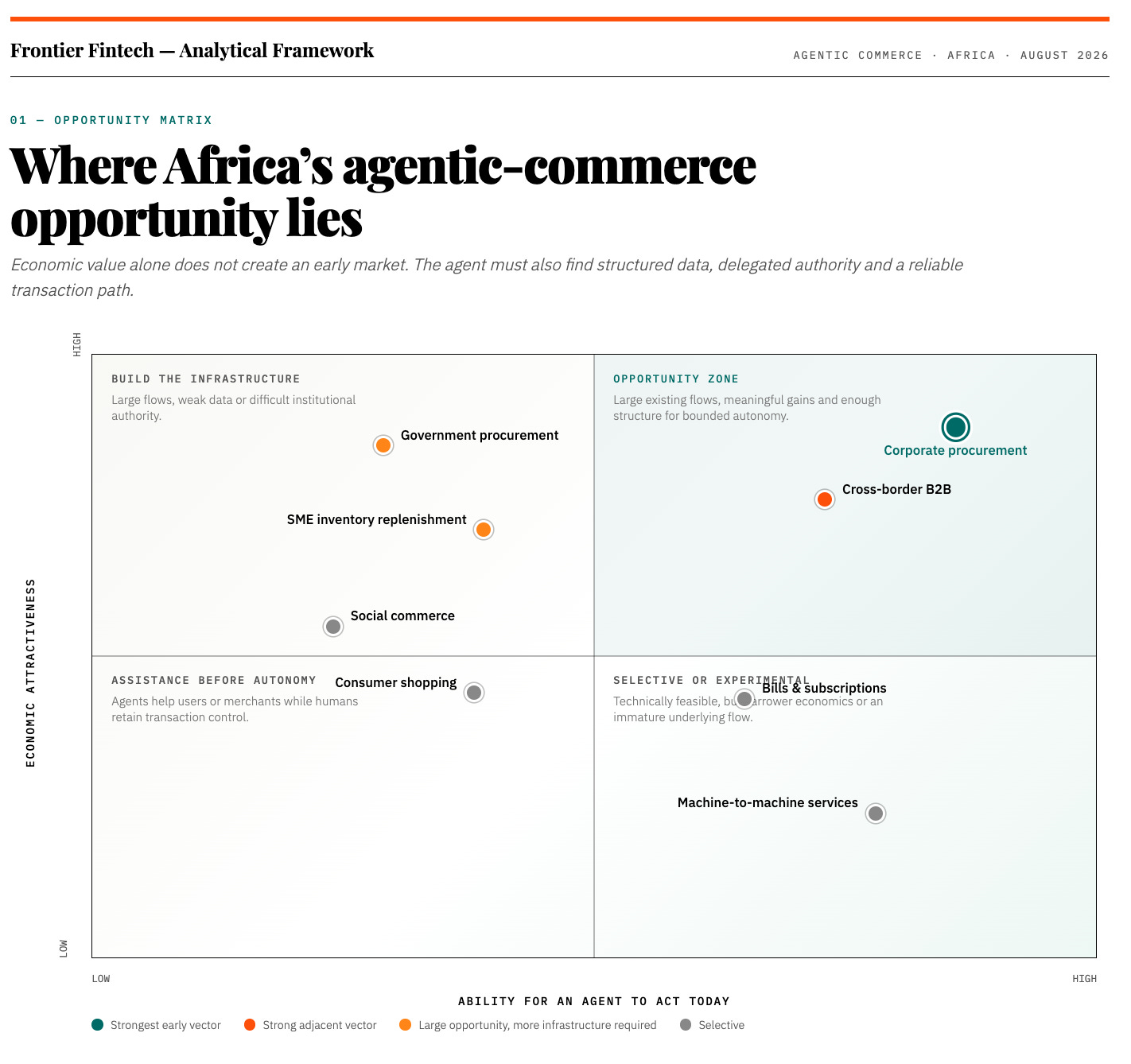
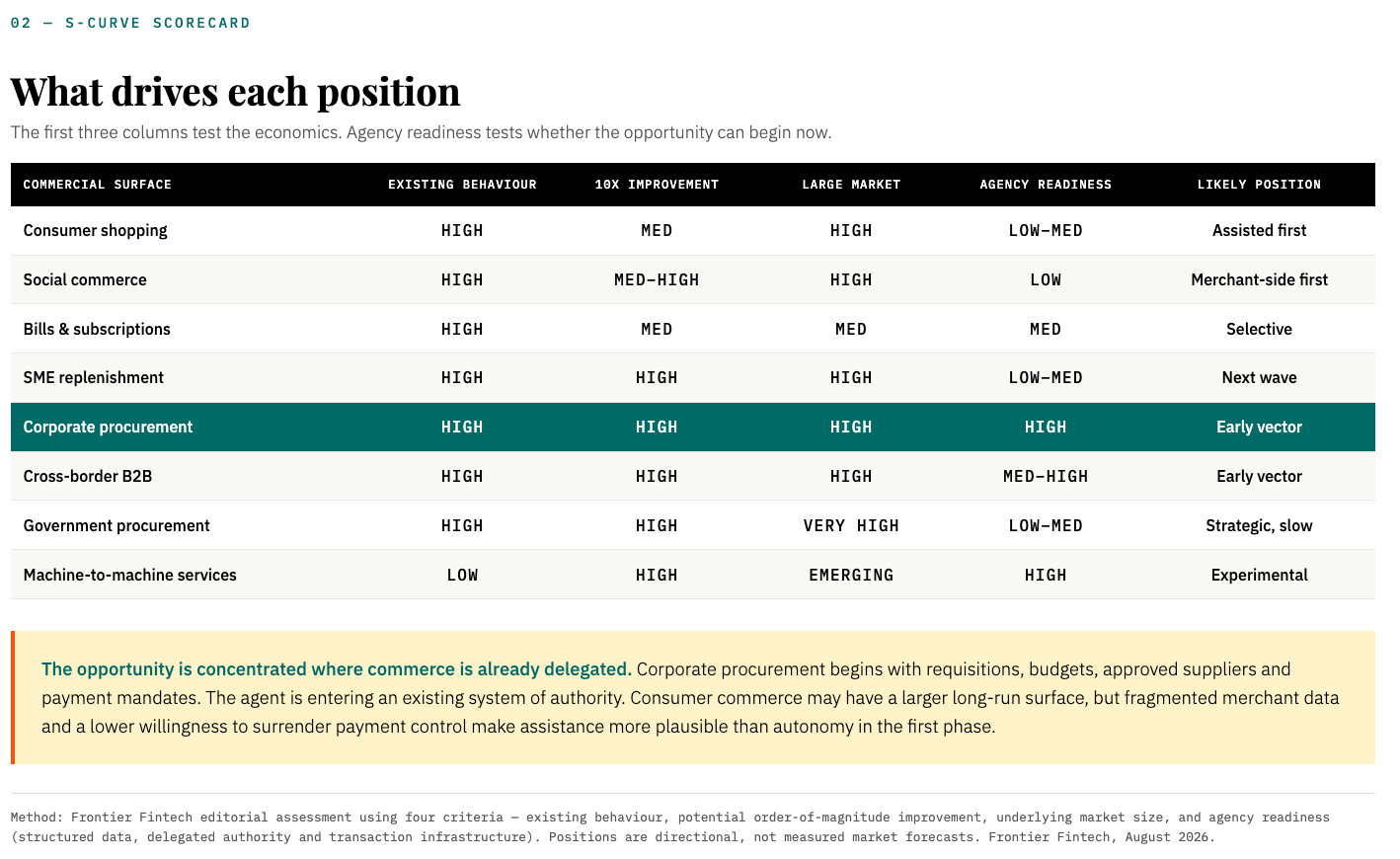
Consumer commerce passes the market-size test, but fragmented catalogues and limited delegation constrain the initial opportunity. SME inventory replenishment is promising, although its data remains fragmented.
Corporate procurement combines the three S-curve conditions more cleanly. Companies already express intent through requisitions, delegate authority through budgets and approval mandates, and transact through purchase orders, invoices and bank payments. The relevant data often exists inside ERP, procurement and treasury systems. Spending is concentrated among large corporates, governments and their supplier networks.
The potential 10x improvement lies in reducing the effort required to discover and onboard suppliers, resolve exceptions, approve invoices, arrange financing and complete cross-border payments. It may provide the more credible starting point for Africa’s first consequential agentic-commerce curve.
The Procurement Opportunity
In our view, one of the largest vectors for agentic commerce and payments in Africa will be B2B procurement. The opportunity sits inside enormous existing flows. Eskom recorded R220.3 billion, approximately US$12 billion, in measured procurement spend during FY2025. Shoprite spent R146.5 billion, or roughly US$8 billion, with black-owned businesses, while Sasol spent R42.6 billion, approximately US$2.3 billion, with black-owned suppliers alone. Eskom, Shoprite, Sasol
Safaricom does not disclose an equivalent procurement figure. Its KSh91.3 billion, approximately US$708 million, in FY2025 capital expenditure nevertheless gives us a sense of the contracts flowing to network-equipment vendors, tower companies, technology providers and construction firms. These anchor buyers sit at the centre of supply chains containing thousands of smaller businesses. Safaricom
Much of the underlying workflow is already digitised. A corporate buyer raises a requisition, checks it against a budget, selects an approved supplier, issues a purchase order, records delivery and matches the supplier’s invoice before payment. Sasol uses SAP Ariba for several of these processes. Shoprite exchanges orders and documents through a supplier portal, while Eskom receives formal tenders electronically.
This structured data creates room for agents to optimise the broader supply chain. An agent could compare demand forecasts with inventory, identify an impending shortage, assess supplier capacity and allocate orders across several vendors. It could monitor delivery performance and revise procurement plans when a shipment is delayed.
The harder problem begins when reality departs from the happy path. A supplier may deliver 90% of an order. The invoice may contain a small price discrepancy. A tax certificate may have expired, or a service-entry record may be missing. Conventional software flags the mismatch and moves the transaction into a manual queue. This then leads to delays and one of the consequences is large corporates stay away from smaller suppliers due to these documentation issues.
The commercial consequences travel beyond the procurement department. The supplier has already paid for materials, transport and labour. A delay in validating the delivery postpones invoice approval, which then postpones payment. IFC’s assessment of supply-chain finance in Kenya found that MSME suppliers can wait more than 90 days to be paid, despite paying their own suppliers upfront or within 30 days. They struggle to replace inventory, accept new orders or pay businesses further upstream. IFC
Agentic reasoning could shorten this gap. An agent could examine the purchase order, delivery record, contract and invoice together; identify the cause of the discrepancy; request missing evidence; and approve routine deviations within a defined mandate. Material contract changes, suspected fraud and conflicts of interest would remain with humans.
Once the invoice is accepted, it becomes a financing event. The agent could compare an early-payment discount with the buyer’s cost of capital, offer the approved receivable to several banks or factoring providers, and allow a financier to pay the supplier immediately while the buyer retains its original payment terms.
The supplier can then purchase inventory, pay employees and settle its own creditors earlier. A decision made inside the anchor buyer’s procurement system begins moving liquidity through the rest of the supply chain. This is an interesting vector for agentic commerce and payments and lends itself to what large manufacturers in the region are already doing. I was at an event a couple of weeks ago and spoke to the COO of one of Kenya’s largest manufacturing conglomerates and it was interesting to hear about how rapidly large orgs are experimenting with AI.
I’ve always argued that transaction banking will be a huge area for innovation. I wrote about it here back in 2021 when discussing the future of finance. It’s still early days for agentic commerce and specifically, seeing agents managing procurement. Nonetheless, African corporates will innovate largely because competition and sophistication are increasing. This is not the Africa of the 90s where you could control a choke point and sit comfortably. These competitive pressures could drive experimentation on agentic procurement and the long-term result will be that banks or fintechs that can provide the infrastructure to enable this will do well.
I’d greatly appreciate if you could take 3 minutes max to fill out this survey. I want to make your experience with FF better.
The exception queue is where small suppliers actually lose the money. I run a finishing contractor in Lithuania and the pattern matches: the order is delivered, one line on the invoice does not match, and the whole payment sits in a manual queue while we have already paid for materials and labour. Nobody is disputing the work. Somebody is just waiting to look at it. An agent that can identify the cause of a discrepancy and request the missing document is worth more to us than anything on the discovery side. Discovery was never our bottleneck.
I really enjoyed reading this. It was such an eye opener. You broke it down soo well..