
#126 - The CBN's Impossible Board
A regulator writing rules for a market that generates new positions faster than it can read them.


Illustration by Mary Mogoi (New Link)
Hi all - This is the 126th edition of Frontier Fintech. A big thanks to my regular readers and subscribers. To those who are yet to subscribe, hit the subscribe button below and share with your colleagues and friends.
I’d greatly appreciate if you could take 3 minutes max to fill out this survey. I want to make your experience with FF better.
Introduction
Is the Central Bank of Nigeria over-regulating the fintech industry it helped create? A read of the news coming out of Nigeria seems like an endless list of Central Bank edicts across FX, Agent Operations, Payments and the entire Fintech Stack. One is left to wonder whether the CBN is becoming overbearing. The truth is more nuanced.
Before we can answer the question of whether the CBN is overreaching, it helps to leave Lagos entirely and travel to Santiago, to a problem that had nothing to do with fintech and somehow everything to do with it.

Image of Salvador Allende - Image Source
In 1971, Salvador Allende’s government had a control problem. Chile had just nationalised a large part of its economy, bringing copper, textiles, and hundreds of firms under state ownership within months of his election. No ministry in Santiago had any real idea how to run them. A planner could nationalise a factory with a signature. Knowing whether that factory was short of raw materials, overstaffed, or three days from a stoppage was another matter, and it was happening across hundreds of plants at once.
The government turned to a British cybernetician named Stafford Beer, whose field was the study of how complex systems regulate themselves, the way a body holds its temperature steady without the brain instructing each cell. Invited to Chile by a young technocrat named Fernando Flores, Beer arrived with an idea that was radical for its moment: build the economy with a nervous system.
The result was Project Cybersyn. Beer’s team laid a network of around 500 telex machines across the country, one in each nationalised firm, each relaying daily production data to a single mainframe in the capital. At the centre sat the Operations Room, a hexagonal chamber of moulded swivel chairs and screens where officials could watch the economy report on itself in real time. It looked like the set of a science-fiction film. It was, in truth, an attempt to see.

The actual control room for Project Cybersyn in Santiago - Image Credits (MIT Press)
Its moment came in October 1972, when some 40,000 truck owners, backed by Allende’s opponents, went on strike and tried to choke a country that runs on road freight. On paper the blockade should have worked. But the government had the one thing the strikers did not: a live picture of where everything was. Using the telex network, officials coordinated the few hundred trucks still loyal to them and routed supplies around the blockade faster than it could close roads. A small, well-coordinated system held off a far larger one. Cybersyn had not planned the economy in any grand sense. It had sensed it, and that turned out to be enough. The idea of sensing rather than control is a theme we’ll come to.
That distinction was the lesson Beer carried out of Chile. Faced with a system too complex to command, the answer was not more control from the centre. It was more visibility, and the discipline to let the parts sort themselves out once the centre could see. He never got to prove it at scale. On 11 September 1973, Pinochet’s forces overthrew Allende, and the Operations Room was dismantled.
To see how this applies to Nigerian Fintech, we’ll start by looking at how the Nigerian Fintech sector has evolved over the last 15 years, understand the competitive dynamics that shape the market and infer the Central Bank’s rational approach to regulation.
A Short History of Nigerian Fintech
It’s useful to take a short trip down memory lane to understand how Fintech in Nigeria evolved and how the CBN developed its relationship with the industry.
In 2009, Tayo Oviosu found a telephone number on the Central Bank of Nigeria’s website and called it. He was pitching an idea he called “PayPal for Africa,” he had no licence, and he knew no investor would back him without one. The call was eventually transferred to a young official quietly drafting a regulatory framework for mobile payments, who agreed to meet him in Lagos. Oviosu’s team spent a month preparing a 300-page application, and he flew to Abuja with a suitcase of printed binders and thumb drives setting out where every server would sit and how every process would run.
When Paga finally worked its way up to the Governor, Sanusi Lamido Sanusi, something telling emerged. By Oviosu’s account, Sanusi had never heard of mobile money, or of M-Pesa, by then two years into transforming payments in neighbouring Kenya. His own team had been building the framework without his knowledge. He judged it good for financial inclusion, told them to publish it and start licensing, and in doing so invited the competition Paga would spend the next decade navigating. You can watch the podcast where we have this conversation below.
That improvisation hardened into strategy in October 2012, when the CBN published its National Financial Inclusion Strategy. The document was serious and quantified. Some 46.3% of adult Nigerians were financially excluded, and the plan was to cut that to 20% by 2020 while lifting formal inclusion from 30% to 70%. It benchmarked Nigeria against Kenya, Brazil and Mexico, and it named the instruments meant to close the gap: tiered KYC to admit those without full documentation, a consumer protection framework, and above all agent banking, a channel in which Nigeria then scored zero agents per 100,000 adults against Kenya’s 154.
One choice inside that strategy still runs through the market today. Inclusion in Nigeria would be bank-led. Where Kenya had allowed a telecoms company, Safaricom, to build and own M-Pesa, Nigeria’s banks, coordinated through the Bankers’ Committee, insisted that deposit-taking institutions sit at the centre of any mobile money system. The mobile network operators that had the reach and the airtime rails to move money nationally were held to a supporting role for the better part of a decade.
The intent was to protect the banking system and keep monetary control in regulated hands. The effect was to foreclose the one route by which a single dominant player might have emerged. No Nigerian Safaricom was permitted to form. Into the space where a monopoly might otherwise have consolidated, dozens of licensed banks, processors and start-ups poured instead, each laying its own rails, signing its own agents, building its own acceptance network. Kenya’s inclusion story produced a single dominant network; Nigeria’s produced a crowd of competitors with no centre. It shaped the market for years to come and has shaped the regulatory landscape that the CBN now governs.
Survival of the Fittest - Competition and Industry Structure in Nigerian Fintech
As we discussed in the Cobra Effect, the bank-led strategy created a market where Fintech innovators came into the commercial vacuum that was inevitable in a bank-led Fintech ecosystem. Moreover, in Nigeria the competition runs the length of the stack. In payments acceptance, Paystack, Flutterwave, Interswitch and Moniepoint fight for merchants any one of them would happily hold alone. In agent banking and mobile money, OPay, PalmPay and Moniepoint have each built networks running into the hundreds of thousands, burning capital to sign the same shopfronts. In cross-border remittances, a widened licence pool produced a scramble of IMTOs, LemFi, Nala and dozens more competing on the price of a dollar sent home. In digital lending, FairMoney, Carbon, Branch and a long tail of app lenders chase the same thin-file borrower. Every layer that can be contested is contested.
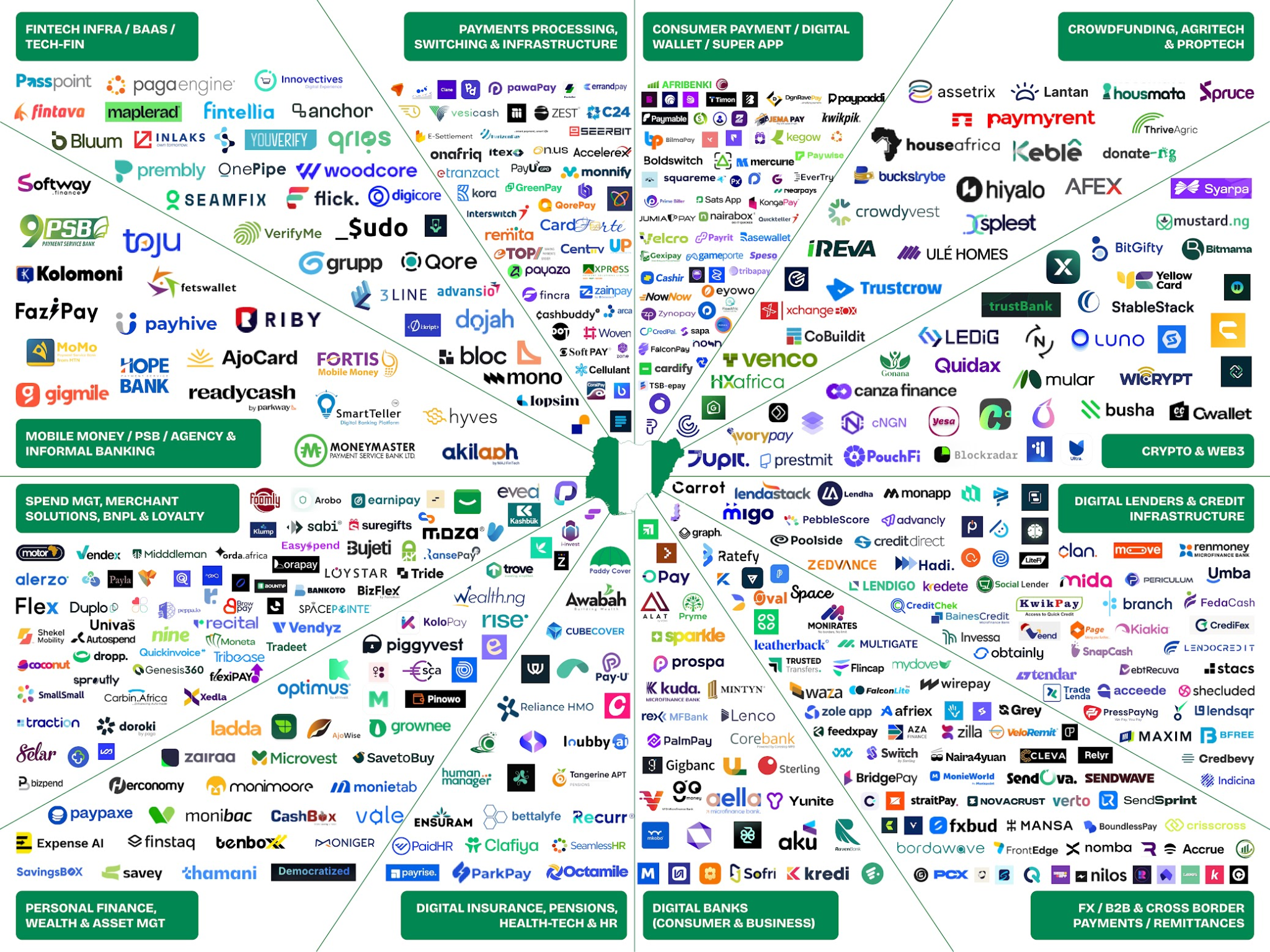
Nigerian Fintech Market Map - Image Source
Competition also shapes what a participant is willing to see. Consider an agent network that notices a sudden spike in volumes across part of its estate. The spike is ambiguous. It might be genuine growth, or it might be a laundering pattern, terminals turning over sums no legitimate shop could sustain. Separating the two means stopping to look. But that same spike is the number that reassures a board, satisfies an investor, and anchors the next fundraise. One impulse says investigate; the other says report the good news and move on. In a market this contested, the second usually wins. The instinct to interrogate a suspicious number is real, but it is quiet, and it is permanently outweighed by the need to show the line going up. This is not a lapse that better management corrects. It is a standing property of competition, and it means each participant has a reason to look away from precisely the signal a regulator would most want examined. We’ve all been there, the pressure to show numbers overpowers the need to double click on what’s driving those numbers a lot of the time.
Across the continent, Kenya arranged these functions differently albeit not necessarily by design. Safaricom, through M-Pesa, is the dominant payments network, the dominant mobile money operator, a dominant force in digital lending through M-Shwari and Fuliza, and the backbone of cross-border money movement. Airtel Money, Fintechs and the banks compete for the smaller share of a market whose centre of gravity sits inside one company. When one firm sits at the centre of every layer, the Central Bank of Kenya has a single point of leverage. It can summon one chief executive, inspect one set of books, and move the whole system through a single conversation. There is, in the old phrase, a single neck to choke, and, just as usefully, a single place to look.
The Central Bank of Nigeria has neither. The function Safaricom performs alone in Nairobi is spread across dozens of licensed, well-funded competitors, each with its own systems and agents, each racing the others hard enough that the market never holds still, and each carrying its own quiet incentive to leave its anomalies unexamined. There is no single neck to choke, and no single place to look. Competition delivered the outcome the 2012 strategy wanted. It also dismantled the one thing a supervisor leans on to keep order: a legible centre.
It’s a standing feature of both ecosystems. As much as the Central Bank of Kenya would want competition, they have also gotten comfortable with having one sizable counterparty to regulate. In as much as the CBN urges competition, they’d also prefer if the regulatory landscape was cleaner.
Empathy and the Law of Unintended Consequences
I have a fair amount of empathy for the position this leaves the CBN in. It supervises a market in which dozens of well-capitalised firms are each looking, continuously and independently, for an edge, and an edge by definition is something nobody has tried before. A new fee structure, a new way of routing a transaction, a new category of agent, a new product that sits awkwardly between two existing licences. Each of these arrives as something the rulebook did not anticipate, and they arrive constantly, from dozens of directions at once. It’s if anything chaotic and not the controlled kind.
There is a concept from cybernetics that I have found genuinely useful for thinking about this, which is variety, meaning the number of distinct states a system can occupy. Ashby’s Law of Requisite Variety, which comes from the same body of work that Beer was drawing on in Chile, says that only variety can absorb variety. A controller can regulate a system only if its own repertoire is at least as rich as the range of states that system can produce. Where the controller falls short, what it loses is not effectiveness in general but the ability to act on the specific states it cannot see. That framing is what makes competition awkward for a supervisor. Every firm in a contested market is being paid, in effect, to manufacture states the regulator has not encountered, and the more competitive the market the faster they arrive. The controller, the CBN in this case has to constantly create new tools to deal with the compounding variety.
The CBN’s answer has been to write. In the twelve months to July, it issued a consolidated agent banking rulebook, geo-tagging requirements alongside the ISO 20022 migration, a circular on dual connectivity, revised market access for bureaux de change, amendments to the BVN and watch-list framework, new ATM guidelines, baseline AML standards, a market structure circular capping combined issuing and acquiring share, a ring-fencing exposure draft, and a portal for tracking retail dollar purchases. March gives you the pace at its most concentrated: ten instruments in twenty-two days, ending on the 31st with a Guidance Note issued to explain the standards published three weeks earlier.
The agent banking guidelines of October 2025 are an interesting case study because they show how far into the operation of a business this kind of instrument reaches. They pulled together the 2013 agent guideline, the 2015 super-agent framework and a 2023 exposure draft into a single rulebook. An agent must now serve one principal only, with the option to switch after twelve months. Every terminal must be geo-tagged and geo-fenced to its registered premises, originally within ten metres. All agent transactions must run through a dedicated wallet held with the principal, personal accounts are prohibited, and breach carries blacklisting. Customers are limited to ₦100,000 ($73) a day and ₦500,000 ($365) a week, while the agent may process no more than ₦1.2m ($ 880) of cash-out daily. Two-factor authentication applies to every transaction, terminal aggregators must register devices and connect their management systems to the CBN’s reconciliation platform, and principals file daily agent reports while carrying full liability for what their agents do.
Empathy is critical because the CBN is responding to genuine threats. They’re not a room of neurotic regulators, rather they are rational actors responding to genuine threats. For instance, agent cash-out is a well-understood laundering channel, where cash enters at one terminal, moves digitally, and comes out as cash somewhere else with the trail thinning at both ends. Fighting money laundering is a core concern for the government specifically whilst trying to stay out of the FATF grey-list. An economy as large and as sophisticated as Nigeria will create a lot of demand for money laundering so the scale of this threat is not trivial. Roaming terminals get used to cash out stolen card credentials a long way from wherever the fraud happened. Nigeria’s grey-listing by the Financial Action Task Force in 2023 attached an external timetable to all of this, and continued correspondent banking access, which is what allows Nigerian banks to touch the dollar system at all, depends on being seen to deal with it. These are real problems and can’t be wished away.
The difficulty is in what the instruments do to the agent once they are combined and the law of unintended consequences. An agent earns commission on throughput, so a daily cash-out ceiling functions effectively as a daily income ceiling. Under the previous arrangement a busy agent ran three or four terminals from different principals and spread volume across them, which meant the practical ceiling was some multiple of any one provider’s limit. Exclusivity collapses that to one. So the ₦1.2m cap bites considerably harder in 2026 than the same number would have bitten in 2024, and it does so because a separate rule, written for a separate purpose, removed the way around it. What the two produce together is a ceiling on what agency banking can earn, weighing most heavily on the highest-volume agents, who tend to be the ones anchoring cash liquidity in their areas. In a country as big as Nigeria, the effective demand for agent cash-out at a busy market in Lagos is magnitudes larger than what the CBN rules impose.
Where that leads is uncomfortable, and I do not think it has a clean answer. Agents are the last-mile channel the 2012 strategy was built around, the thing that carried Nigeria from zero agents per 100,000 adults to one of the densest networks on the continent. If the work pays less, fewer people do it, and fewer agents means fewer points at which physical cash converts into digital value. Cash that never enters the system is cash nobody can see. Set against that, Tayo Oviosu’s observation that the main thing people use agents for is withdrawing cash, which sustains cash use rather than displacing it, is also true. The agent is at once the cash economy’s most convenient counter and the only bridge the digital system has into it, and an instrument aimed at the first will land on the second. Simply, these rules whilst rationally arrived at threaten to hamper Nigeria’s digitisation efforts and push the country backwards in terms of financial inclusion and digitisation of cash.
The Aim is to See

Image of Stafford Beer - Image Credit
What strikes me about Beer’s conclusion is how counterintuitive it is for anyone whose instinct is to govern. He was building a machine for a state that had just taken ownership of hundreds of firms and needed to run them, and what the machine kept telling him was that running them was the wrong ambition. The telex network never planned anything. During the strike it simply showed the government where the trucks were, and that turned out to be worth more than any instruction the centre could have issued, because the people driving the trucks already knew how to drive them.
Applied to the agent estate, the equivalent is not difficult to picture. Every terminal already reports. Aggregators already link their management systems to the CBN’s reconciliation platform. The data that a supervisor would need in order to see the network in something close to real time is largely being produced already, and is currently being used to check compliance with fixed thresholds after the fact.
The alternative use is to let the principal move the threshold. A principal like Palmpay or OPay knows things about an agent that no circular can encode: how long the shop has been trading, what its normal daily pattern looks like, whether the operator has been through training, what its dispute history is, whether the surrounding market has a reason to be busy this week. Give the principal authority to raise a well-documented agent’s limits within a defined band, and to cut them the moment behaviour departs from pattern, and the ceiling stops being a number chosen in Abuja for every agent in the country and becomes a live judgement about a particular business. The high-volume agent, currently penalised for being useful, can grow. The principal gains a commercial instrument it can actually compete on. And the CBN, rather than specifying the limit, specifies what the principal must demonstrate: that limits are set against stated criteria, that anomalies are flagged within a defined window, that the record is complete and auditable. It senses compliance against a standard instead of enforcing a figure.
This puts the burden where the liability already sits, which is the part of the current guidelines that creates dissonance. The CBN has made the principal fully answerable for its agents’ conduct while removing the principal’s discretion over the levers it would use to manage that exposure. You cannot delegate the risk and retain the controls. If the principal carries the loss, the principal should own the method, and the regulator’s job becomes verifying that the method works.
I should be careful here, because principles-based supervision has a bad history. The UK’s Financial Services Authority went into 2008 with a principles-based rulebook and what it produced was light touch, which is a different thing entirely. The distinction is visibility. Principles are only enforceable by a regulator that can see outcomes without prescribing methods, and that is precisely the layer Nigeria has been building: BVN since 2014, still standing and never replaced; the reconciliation platform sitting inside these same agent guidelines; the FX tracking portal launched in July. The CBN plainly knows how to build the durable kind of instrument.
Which is where I find myself still turning something over. Beer built Cybersyn to help a socialist government hold an economy it had just taken hold of, and the lesson he carried out of Santiago was that the holding was never the point. Beer’s conclusion was that as variety increases, the value moves from control to sensing. Allende was kicked out in 1973, and Cybersyn was never allowed to mature. Nonetheless, in its short existence, it was a useful experiment in the value of data in managing a complex systems. The value lies in having visibility. The Central Bank of Nigeria has already built the visibility infrastructure, the best use of this infrastructure is to monitor and enforce rather than to permanently prescribe.
I’d greatly appreciate if you could take 3 minutes max to fill out this survey. I want to make your experience with FF better.
The comparison between Nigeria and Kenya is apt! Never saw it that way.