
#125 - Where Are Your Dollars Going?
The offshore dollar has a seventy-year history and a new digital form. Why USDT will remain Africa’s core cross-border rail stablecoin.

Illustration by Mary Mogoi (New Link)
Hi all - This is the 125th edition of Frontier Fintech. A big thanks to my regular readers and subscribers. To those who are yet to subscribe, hit the subscribe button below and share with your colleagues and friends.
Introduction
It has been a frenetic few weeks in the stablecoin business. In June, a consortium called Open Standard unveiled Open USD, a dollar token whose backer list reads like a who’s who of global finance and technology: Visa, Mastercard, American Express, BlackRock, BNY, Standard Chartered, Stripe, Google, Coinbase, and some 130 others, gathered around a promise to build open, shared payments infrastructure in which the income earned on the reserves flows back to the partners rather than into a single issuer’s pocket. The token is not yet live; the launch is expected later in the year, but the announcement alone was enough to take roughly a sixth off Circle’s share price in a single session. Circle, whose own shares now trade on the New York Stock Exchange, spent the days that followed writing cheques of its own: its venture arm took a strategic stake in Flutterwave to embed USDC settlement across the continent’s largest payments network. Flutterwave was not short of stablecoin suitors this quarter; weeks earlier, Ripple had bought into the same company at a $3.2 billion valuation to make its RLUSD the default token on those same rails. Whatever else one takes from all this, the capital is unmistakably moving, and it is moving loudest at the institutional, dollar-issuing end of the market.
To an outsider, it seems that the big boys are firmly entering the space motivated by the increased demand for stablecoins for cross-border settlement. All of this leaves a couple of questions: as a treasurer at a bank or a large financial institution, how should I think of the broader space and where do I place my bets? One thing that Open Standard is doing quite well is that it’s building a consortium of participants much like how SWIFT, Mastercard, or Visa came to be - consortia that defined open standards that enabled adoption. It’s a smart move and is clearly targeted at the institutional layer. Nonetheless, whenever industries develop, it’s always useful to look at what the principles of economics and finance say and, more importantly, how such moves have played out in history. How will the chips land, and what will the stablecoin market look like in 10 years? My view is that Tether will continue to be the dominant stablecoin rail in emerging markets, and stablecoin strategy in the region will be firmly anchored to USDT. To understand why it’s important to look at some interesting historical parallels.
The Eurodollar Parallel
To understand why I am bullish on Tether, it’s important to understand what is, in effect, Tether’s predecessor, the Eurodollar. Eurodollars are effectively dollars that exist and move outside the US payments system. From dollar balances that flow through London to the dollars that are traded in Kinshasa. They are created whenever a bank outside the United States holds and lends dollars without the money clearing through the Fed, a claim on a real dollar that circulates offshore until the moment it needs to route through the correspondent banking system.
The origins of the Eurodollar are genuinely murky, and the historians who have gone looking for the first one tend to give up and settle for a handful of plausible stories. The version most often told begins in the Cold War. Communist governments held US dollars because dollars were what the world traded in, but they had no wish to keep those dollars inside the United States, where a diplomatic quarrel could see them frozen. China is said to have moved its holdings out of American reach around 1949; the Soviet Union followed through the 1950s. In February 1957, the London branch of the Soviet-owned Moscow Narodny Bank placed a few hundred thousand dollars with Western banks on Moscow’s behalf. Much of this activity was routed through a sister institution in Paris, the Banque Commerciale pour l’Europe du Nord, whose telex address happened to read “Eurobank.” The offshore dollars that gathered in these accounts took their name from it.
What mattered was not the espionage but the mechanics. These were real dollars, claims that could ultimately be redeemed for the genuine article, yet they lived on the books of European banks and changed hands between them without ever passing through the American payment system. A dollar could be lent, borrowed and re-lent across London and Paris without a single instruction reaching a bank in New York. It was a dollar that existed outside the machinery its issuer controlled.

Britain gave the market its commercial reason to exist. Through the 1950s the country was fighting a chronic balance-of-payments problem, and after the Suez crisis of 1956 the authorities restricted the use of sterling to finance trade between third countries, a blow to London banks whose business had always been lending to the world. Midland Bank had already found the way around it. As early as 1955 it discovered it could bid for dollar deposits at rates higher than banks were permitted to offer in New York, swap those dollars into sterling, and fund itself more cheaply than the domestic market allowed. The manoeuvre created, almost as a by-product, a market in offshore dollars. The Bank of England watched the dollars flow into the City, judged them good for both the balance of payments and London’s standing, and chose to look the other way.
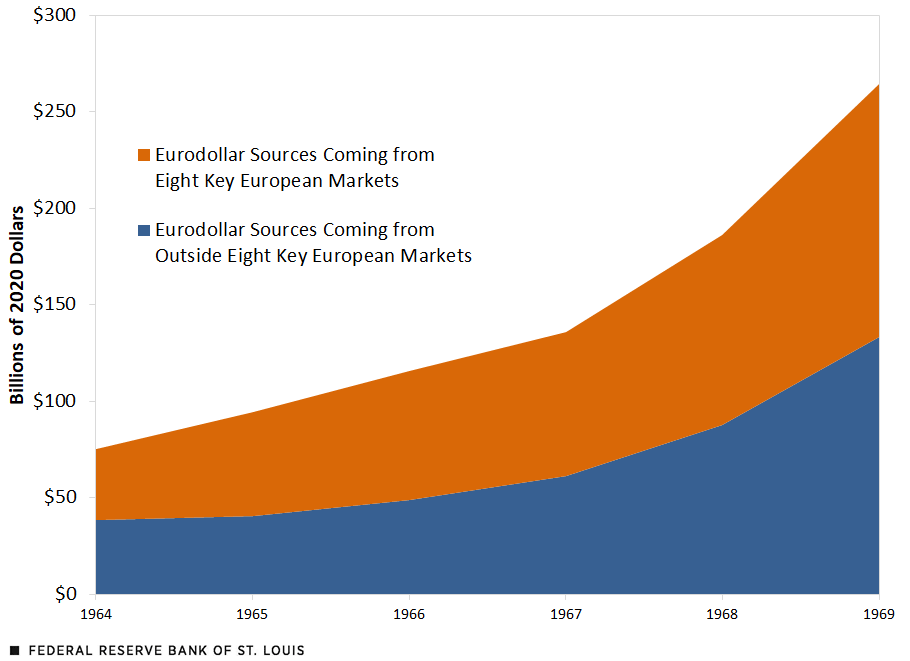
Graph showing growth in Eurodollar Markets - Source St. Louis Fed
American regulation did the rest of the work. Under the Federal Reserve’s Regulation Q, banks in the United States could not pay interest above a set ceiling on deposits. A depositor who placed his dollars in London, beyond that ceiling’s reach, simply earned more. The spread pulled dollars offshore in rising volumes, and in time it pulled the American banks after them. First National City, Chase, Bank of America and Morgan Guaranty opened London branches, gathered Eurodollar deposits at rates they could never match at home, and lent them back to head office to sidestep the constraints of the domestic market. The rule written to discipline American banking had quietly built a rival to it offshore.
By the 1970s the market had become the world’s plumbing. When the 1973 oil shock handed OPEC enormous dollar surpluses, those dollars were deposited into the Eurodollar market and lent onward, recycled, in the language of the day to finance governments and infrastructure across Latin America, Africa and Asia. The petrodollar and the Eurodollar were, in practice, the same dollar caught at two moments in its journey. Something of that market survives in physical form even now. The banknotes that change hands in Kinshasa or move through the markets of South Sudan are, functionally, Eurodollars. They price goods, settle debts and store value across whole economies, and most of them will never again pass through the Federal Reserve. They are dollars that left the American system and simply kept working. Eurodollars are all around us and they circulate within the banking system, they only become proper dollars when they need to go through the US payment system through correspondent banking. This is critical to keep in mind when thinking about the current stablecoin issuance market. Ask yourself, which dollars are being issued.
Interestingly, neither the Federal Reserve nor the Bank of England intervened to stop or regulate this market and the reasons why are instructive. The Federal Reserve could see that the offshore market was carrying the dollar into corners of the world it would otherwise never have reached, and a wider dollar was a stronger dollar. The Bank of England could see that the same market kept London at the centre of global finance long after sterling had stopped being a global currency. The issuer tolerated it because it extended American influence; the host tolerated it because it conferred relevance. An offshore dollar, answerable to no one in full, turned out to suit almost everyone with the power to rein it in. Again, another critical thing to keep in mind. At its core, what this shows is that regulation is not driven entirely by edict, but rather by shared incentives.
From Eurodollar to USDT
This bit of history is important as it helps us understand Tether much better. What it grounds is that there is a fundamental difference between dollars flowing through the US banking system and those that live exclusively outside that perimeter. This bifurcation has existed for over 70 years and has continued to define how the world works. A lot of what we experience as struggles with the correspondent banking system are in fact an incompatibility problem between offshore dollars and Fed dollars.
USDT is therefore an offshore dollar in the fullest Eurodollar sense. It is a dollar claim that lives outside the American banking system, held and moved by people who want dollars and find the formal channels for holding them expensive, slow, or closed. When set aside, the parallels are remarkable.
Both were born of necessity, not design. The Eurodollar began as asset protection for governments that needed dollars but not American jurisdiction; USDT found its first market among Chinese traders who wanted a dollar they could hold without the yuan and without a bank’s permission.
Both grew out of utility. For Eurodollars, London banks found a way to continue their international lending business using Eurodollars. For USDT, individuals and businesses found a way to make international trade and remittance payments without being locked out of the correspondent banking system.
Both compound as network assets. Every exchange that quotes USDT, every market maker that supports it, every wallet that integrates it makes the token more useful to the next holder, who deepens it for the one after. Liquidity, uniquely, grows more valuable the more of it there is. Past a point, both the Eurodollar and USDT achieve escape velocity where they become the primary rail. In conversations with people in the industry, it’s clear that USDT accounts for over 95% of stablecoin payments in the continent.
Both are tolerated by the issuer of the currency, for the same reason. The Fed let the Eurodollar run because a dollar used everywhere is a stronger dollar. Tether now holds around $141 billion in US Treasuries, the seventeenth-largest holder on earth, ahead of South Korea and Germany, which, with China running its own holdings down, makes it a marginal buyer of US debt that Washington is in no hurry to discourage.
Put plainly, Tether digitises the Eurodollar. It takes the offshore dollar balance, historically a ledger entry on a foreign bank’s books, redeemable but immobile and places it on a public blockchain where it moves between strangers in seconds, for cents. It’s a technological innovation on an existing off-shore dollar system.
It also clears every bar I’ve argued a mass-adoption S-curve must clear:
Behaviour that already exists;
An order-of-magnitude cost collapse;
Distribution that reaches the masses;
And enough depth to solve the network-good problem.
The numbers follow. USDT’s supply sits near $183 billion, three-fifths of the stablecoin market, and on Yellow Card it takes 88.5% of transaction volume against USDC’s 9.9%. Most people I speak to report a USDT share of 95% and above. In effect, on most African venues it is not one option among several. It is the base pair.
The Scaling Advantage
The history of finance is largely a history of innovation running ahead of the rules. The Eurodollar market grew for two decades before the Basel Committee existed to supervise it, and the American banks that built it moved into London without waiting for a rulebook, because the business was good and the alternative was to cede it. M-Pesa launched in Kenya in 2007 and reached national scale years before the payments regulations caught up with what it had already become. In each case the regulator arrived late, and arrived because the market had grown too large to ignore. This is the normal order. Regulators are not paid to run ahead of the market; they are paid to make sense of it once it arrives, and any strategy that waits for full regulatory clarity before committing is one that will always move last. Whenever I speak to VCs that are looking at this stablecoin powered remittance space, I always tell them that regulation will come, but that shouldn’t worry them. Their focus should be on utility and demand.
Seen this way, the case for USDT in emerging markets rests on the same three foundations that carried the Eurodollar and M-Pesa before it:
Real utility. In the cross-border corridors that matter to African businesses, USDT already moves money faster and more cheaply than the correspondent system it competes with.
Self-reinforcing liquidity. The deeper its markets grow, the more useful the token becomes, and the more useful it becomes, the deeper its markets grow. This liquidity is self-reinforcing and it creates a network effect. There’s deep liquidity across many USDT/local currency pairs and the exchange rate tightly mirrors that for USD/local currency.
Product-market fit in the global south - in exactly the way the Eurodollar found its home outside the United States. The dollar that African savers and traders reach for is not the one issued under American supervision. It is the offshore one.
The obvious objection is the missing backstop, and it is important to understand. USDT is fully reserved rather than fractional, each token sits against real assets, most of them Treasury bills, with a full audit now said to be close, so it does not manufacture dollars the way the Eurodollar’s redeposit chains did. What it lacks is a formal lender of last resort. But the question that matters is not whether one exists on paper; it is whether the Federal Reserve could comfortably let one of the seventeen largest holders of US government debt fail. A disorderly collapse of Tether would mean the forced liquidation of well over a hundred billion dollars of Treasuries into the market, precisely the kind of event a central bank exists to prevent. The backstop is not written down. It is implied by the size of the position, which is exactly how the Eurodollar’s backstop worked for the two decades before 1974, when the G10 finally admitted in Basel that the means to support the market were available and would be used if needed. This was akin to Mario Draghi’s “whatever it takes” comment that anchored markets during the Global Financial Crisis.
Which is why this summer’s flurry of institutional launches, for all its weight, is aimed at a different market. Circle’s USDC and the Open USD consortium are Fed-facing dollars; compliant, audited, built to satisfy American and European supervisors and their competition is not USDT. It is SWIFT, the correspondent system, and the tokenised bank deposits now being readied to run over SWIFT’s own blockchain ledger. They are fighting to modernise the plumbing of the global north, and that is a real and large prize. It is simply not the same prize.
For anyone running a treasury at a large African bank or fintech, this is where the decision actually sits, and it is the same decision the American banks faced in the early 1960s. Midland Bank had found an arbitrage in the offshore dollar and was quietly profiting from it; the giants; First National City, Chase, Bank of America could either dismiss it as a curiosity or move to London and participate. The ones that waited watched the business route around them. The African treasurer faces that choice now in miniature. If your flows run Africa to Africa, or Africa to Asia and the Middle East, USDT is already where the liquidity is, and the practical question is not whether to trust it but whether to build on it before the fintechs routing those flows do it for you. If your flows run into American or European institutional corridors, the Fed-facing dollars and the tokenised-deposit rails are being built for you, and the same participate-or-be-bypassed logic applies.
None of this was decided by regulation. It was decided by utility, and by incentives that happened to align, the saver who wants a dollar, the issuer who profits from minting it, and the government whose debt that issuer must buy to do so. That alignment built the Eurodollar, it built M-Pesa, and it is building the offshore digital dollar now. These are the dynamics that make Tether Lindy and ensure that they will be a critical rail in cross-border payments in the global south for years to come.
<p>The weird thing about USDT in Africa is it's basically doing what correspondent banking was supposed to do, just faster and without the compliance department. Banks had seventy years to figure this out.</p>
I really enjoyed this deepdive, As a banker turned fintech guy i really loved it, Thank you Samora